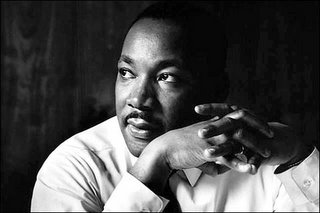
Remembering Dr. Martin Luther King Jr.This year marks the 23rd anniversary of the federal Martin Luther King Jr. holiday, first observed on January 20, 1986. Were he alive today (January 15), King would have celebrated his 80th birthday.
Today millions of Americans are remembering the civil rights leader and human rights advocate. The long holiday weekend approaches, and the U.S. takes center stage as the world prepares to welcome a new American president.
King was a husband, a father, and a preacher. He was also the preeminent leader of a movement that continues to transform America and the world. One of the twentieth century's most influential men, he lived an extraordinary life.
To truly understand King, this writer believes that one should read his writings. Scholars and casual researchers can now gain access to these important jewels of history. Yesterday, for the first time, a major portion of King’s papers went public.
Computer access to the documents, which have been digitized and cataloged, are available at the Robert W. Woodruff Library of the Atlanta University Center. Click here to gain access the collection.
The papers represent more than 75 percent of a 10,000-item collection bought by a group of civic and business leaders in 2006 from King’s family. Atlanta Mayor Shirley Franklin and former Mayor Andrew Young spearheaded the effort to raise $32 million for the purchase.
King scholar Clayborne Carson, founding director of the Martin Luther King Jr. Research and Education Institute at Stanford University, has been named executive director of the papers and distinguished professor at Morehouse College. Morehouse, King’s undergraduate alma mater, is custodian of the collection.
The documents include many of King’s speeches and personal writings from 1946 to 1968.
Journalists, historians, legislators and community leaders continue to examine whether King's appeal for peace with justice is as relevant today as it was when he was alive. A couple of years ago, an editorial in the Houston Chronicle attempted to place King's philosophy into present-day perspective. Here is an excerpt from the piece:
Although he rose to national prominence fighting racial segregation in the South, many of the issues roiling the United States 38 years after his assassination would be very familiar to Martin Luther King Jr.
Before his death, the Baptist minister had denounced America's involvement in the Vietnam War, a daring stance that fueled the growing opposition to the carnage in Southeast Asia. He was bitterly criticized in the media and by government officials for venturing beyond the sphere of civil rights, as if that were the only area in which he was entitled to an opinion.
With the country now split by the bloody, open-ended struggle in Iraq and by the mistaken justification for going to war, it's not hard to predict where King would stand on the matter.
Americans debate the revelation that their government is conducting warrantless surveillance of Americans inside the United States. King had plenty of experience on that score. He was relentlessly wiretapped and trailed by the FBI. Then FBI Director J. Edgar Hoover was convinced that King was a communist sympathizer.
Just as he stood with refuse workers in Memphis in the last days before an assassin's bullet struck him down, King would championed the dispossessed evacuees of Hurricane Katrina, potent symbols of a race-based economic underclass that persists as a legacy of slavery and discrimination. The New Orleans nightmare that Katrina exposed indicates that the vision King enunciated in his "I Have a Dream" speech is not yet realized.
Like his role model for nonviolent protest, Mohandas K. Gandhi, King grew to be a world figure by embracing universal humanitarian concerns that surmounted ethnicity and religion. As he once said, "Evil is not driven out, but crowded out ... through the expulsive power of something good."
That's why the celebration of his life today cannot be limited to a single community or issue. African-Americans are justly proud that he rose from their ranks, but his life is significant to all Americans.
It's been nearly four decades since King's death in 1968. For years, many scholars have suggested that King faced the same fate that has befallen many a historical figure - being frozen in a moment in time that ignores the full complexity of the man and his message.
On January 20, Barack Obama takes over as the country's chief executive officer. With this historic presidency comes the "thawing" the King legacy.
The brilliance of King's message is being celebrated worldwide. This leader of civil and human rights demonstrated that he was, indeed, "a man without borders."
The dream is no longer deferred. Change is here to stay.
Tags:
Martin Luther King,
King Holiday,
Civil Rights,
Human Rights,
Media by Sistrunk
 Examining the "I Have a Dream" speech


